Food Sort: Puzzle Game
- 4.6
- Rating
- 1.00M
- Installs
- Free
- Price

 Analysis by App-foxy
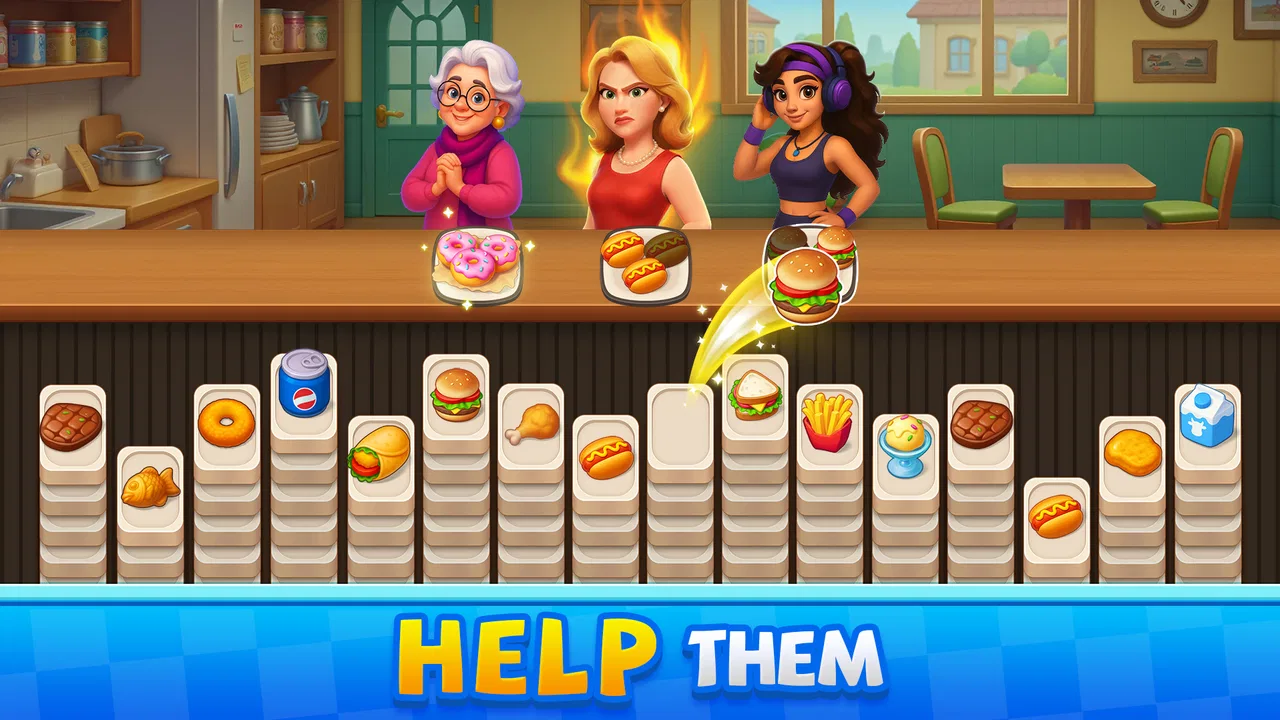
Food Sort: Puzzle Game is the kind of sorting puzzle I can open when I want something gentle rather than demanding. The idea is easy to understand: organize food, match what belongs together, and finish orders. What matters in practice is how that simple loop feels after several rounds. My first impression is of a game built for short, relaxed sessions, with a food-focused presentation that makes the basic act of arranging items feel more inviting than a plain color or shape-matching board.
It is free to download, and Playdayy presents it as a game for Everyone. The app has reached over a million installs and holds a 4.4 average from around four thousand ratings, which fits my experience of a polished, accessible casual title rather than an experimental puzzle game. Its current version is 1.0.17, and it runs on Android 7.0 or later. Those details make it approachable for people using older compatible phones as well as newer devices.
How the food theme shapes the first few sessions
The strongest part of the opening experience is its immediate readability. Food is a familiar subject, so I do not need to learn a fictional world, memorize characters, or understand a complicated objective before playing. The visual language points me toward the task: identify items, place related pieces together, and work toward completed orders. That directness is useful when I am playing during a short break, waiting for an appointment, or winding down before bed.
You May Also Like

 Blood Strike: 2.5 Anniversary
Blood Strike’s Loadouts Turn Every Drop Into a Tactical Gamble
A close look at Blood Strike’s custom loadouts: how fast access to signature weapons reshapes its battle royale rhythm, rewards preparation, and narrows the gap between fights.

 Pandora - Music & Podcasts
Pandora’s Music Is Easy to Start, but Harder to Recover
Pandora’s strength is its low-effort path from a seed to a station. Its weak spot is how much confidence it asks you to place in connection, setup, and quiet recovery.

 8 Ball Pool
 Is Built on Rivalries, Rematches, and Routine
A close look at the rivalries, rematches, shared routines, and unanswered safety questions that turn a quick pool match into a persistent mobile community.

 Samsung Music
’s Quiet Strength Is Playing What You Already Own
Its reach comes less from spectacle than from dependable access to a personal library. That simplicity is both the app’s strongest retention engine and its ceiling.

 AccuWeather: Weather Radar
AccuWeather Review: A Quick, Clear Forecast for Everyday Decisions
For everyday plans, the best forecast is the one you can understand quickly. AccuWeather makes rain timing, radar, and local conditions easy to act on, with a few trade-offs.

 Hill Climb Racing
Why Hill Climb Racing Still Turns Crashes Into One More Run
A tiny car, a bumpy hill and one more upgrade: Hill Climb Racing keeps resurfacing because its simple chaos makes every near-miss feel personal.
More From Our News Desk



The setting also gives the puzzle a warmer personality than a purely abstract sorting board. A row of food items suggests preparation and organization, while the order-based goal gives each small arrangement a reason to exist. I am not simply moving tiles around without context; I am trying to make a little kitchen-style workflow come together. That framing is modest, but it helps the repeated actions feel coherent.
I would not describe the game as a story-driven food adventure. Its appeal comes from the activity itself, not from characters, dialogue, or a large narrative setting. That is an important distinction for anyone choosing between this and a more elaborate cooking game. Here, the food theme is mainly an artistic and mechanical wrapper for sorting. It keeps the board pleasant to look at without asking me to manage recipes, timers, customers, or a restaurant.
The visual approach works best when I treat the game as a calm organizing exercise. I can scan the board, decide what belongs together, and make progress without having to process too much information at once. For younger players and adults who prefer uncomplicated controls, that clarity is a real advantage. The Everyone rating also makes the game easier to recommend within a family, although an adult should still consider whether optional purchases suit the player using the device.
A useful way to read the board
My most helpful habit is to pause before making the first move. Instead of immediately matching the most obvious food, I look at the complete arrangement and identify which spaces may become blocked if I act too quickly. In sorting games, a move that looks correct can still reduce flexibility. I found that planning one or two steps ahead is more valuable than rushing through easy matches.
This is where the food presentation quietly supports the puzzle. Because the objects are recognizable, I can focus on their position and grouping rather than decoding unfamiliar symbols. I also find it easier to remember unfinished groups when the board contains meaningful food categories. That does not turn the game into a complex strategy title, but it gives the simple loop a little more mental texture.
A second useful approach is to separate “progress” from “movement.” Completing one visible group feels satisfying, but it is not always the best immediate choice. Sometimes preserving an open space matters more than finishing the item that catches my eye first. I recommend using the board’s empty room as a resource, especially when several possible matches are available. This small change in mindset makes the game feel less random and more deliberate.
There is also a practical benefit to the order objective: it gives me a natural stopping point. I can play until an order is complete instead of starting a session with no sense of when to put the phone down. That makes the game suitable for short breaks. It is less suitable if I want a long-form puzzle with a carefully unfolding campaign, because the satisfaction is concentrated in individual sorting tasks rather than a deep story or expansive system.
Art direction, sound, and the rhythm of play
The food-centered art direction creates the game’s main mood. I read the board as a tidy, friendly workspace, and that makes the repeated sorting motions feel closer to arranging ingredients than solving an intimidating abstract problem. The theme does not need to be explained at length; it communicates through the objects and the idea of completing orders.
That visual clarity is especially valuable on a small phone screen. A sorting game can become tiring when pieces are visually similar or when the board is overloaded with decoration. Here, the food concept gives each item a recognizable identity, while the overall presentation keeps attention on the arrangement. I still need to concentrate, but the game does not feel visually hostile.
The sound design contributes most when it stays in the background. In a game built around repeated taps and placements, audio should confirm actions without turning every move into an interruption. The resulting rhythm is more about gentle feedback and momentum than dramatic spectacle. I can imagine playing with sound on when I want the game to feel more complete, then switching to silent play when I am in a shared space or listening to something else.
That flexibility matters because this is not a game that depends on audio cues to understand the puzzle. The board communicates the important information visually. If I play without sound, I am not losing the central logic of the experience. When I do use audio, it adds a little polish to the movement from one arrangement to the next, but the game remains playable as a quiet companion.
The pacing follows the same restrained philosophy. Food Sort does not need to overwhelm me with fast reactions to make a sorting task engaging. Its rhythm comes from observing, moving, checking the result, and preparing for the next decision. That slower cadence is a strength for players who want to relax, but it can feel too mild for anyone looking for urgency, competition, or rapid action.
Why the mood works for everyday play
One realistic use case is a short evening session after work or school. I can open the game, complete a few orders, and stop when I feel ready without needing to remember a complicated plot. The food setting helps the activity feel pleasant, while the sorting loop gives my attention something specific to do. It is also the sort of game I would choose during a commute if I wanted a self-contained distraction rather than a social or online-focused experience.
Another use is as a reset between demanding tasks. Sorting familiar-looking objects into sensible groups can provide a small mental change of pace. I would not claim that it replaces rest, but it can be less mentally expensive than a competitive game or a puzzle that requires sustained calculation. The important trade-off is that its calmness comes from simplicity. If I need a strong challenge to stay engaged, the same quality may make the game feel underpowered.
The setting also makes it easier to share the basic idea with someone who does not usually play games. I can explain the objective in ordinary language, and the food theme makes the board less intimidating. That accessibility is one of the title’s clearest strengths. Its weakness is the matching limitation: players who prefer narrative discovery, detailed cooking simulation, or complex progression may find the presentation pleasant but not sufficiently deep.
Where the mechanics fit—and where they may not
At its core, this is a puzzle game about visual organization and completing orders. The mechanical fit with the food theme is natural because sorting ingredients or prepared items already suggests a form of kitchen preparation. The mechanics do not merely borrow food as decoration; the order idea gives the player a reason to arrange things correctly. That connection is simple, but it is more effective than attaching an unrelated theme to a generic board.
The game is a good match for people who enjoy recognizable goals, gradual decision-making, and tactile movement. I especially recommend it to players who like casual puzzles but do not want a timer constantly pushing them. It also suits someone who prefers learning by doing: the basic objective can be understood quickly, while better results come from noticing space, sequence, and the consequences of each move.
It is not my first recommendation for players who want a demanding logic challenge. A dedicated brain-training puzzle, a number-based strategy game, or a harder spatial title will usually offer more complexity and a steeper learning curve. Food Sort is aiming at comfort and accessibility first. Expecting it to behave like a serious competitive puzzler would lead to disappointment.
The free entry point is helpful, but the presence of optional in-app purchases is worth keeping in mind. Individual purchases range from under a dollar to just under one hundred dollars, so I would check purchase controls before handing the device to a child or allowing unsupervised play. The game can be approached as a free casual experience, but the store’s purchase structure means it is sensible to treat spending as a separate decision from downloading.
That distinction is important for families. The Everyone content rating describes the intended age accessibility, but it does not remove the need for normal device-level supervision around purchases. I would be comfortable suggesting the game as a family-friendly puzzle, while still setting a clear rule about when purchases are allowed. For an adult player, the question is simpler: enjoy the free loop if it satisfies you, and only consider an optional purchase if it solves a specific frustration rather than becoming an automatic part of every session.
Small habits that make the sorting loop better
My first practical tip is to avoid treating every completed group as an immediate priority. Before moving a matching item, I check whether that move closes off a useful lane or leaves another group stranded. This is the kind of decision that separates relaxed tapping from thoughtful puzzle play, and it gives the game more depth without making the rules harder to understand.
My second tip is to use short sessions deliberately. Because the game’s mood is calm, it is easy to continue simply because the next order looks manageable. I get more enjoyment when I decide in advance whether I am playing for a quick break or a longer unwind. Stopping after a satisfying completion keeps the experience fresh and prevents the repeated structure from becoming background noise.
My third tip is to judge the game by the quality of its moment-to-moment decisions, not by the size of its theme. The food setting is effective because it makes sorting approachable, but it is not a substitute for a large simulation. If I want to decorate a restaurant, follow a chef’s story, or balance multiple cooking systems, I should choose a different type of game. If I want a clean board, familiar objects, and a gentle objective, this one is much better aligned with that need.
Device compatibility is another practical consideration. Since the minimum requirement is Android 7.0, the game is available to users with many older Android devices, although the exact feel will naturally depend on the phone. I would keep the screen clean and play with enough brightness to distinguish the food items comfortably. The game’s visual recognition is central to its enjoyment, so a cramped or dim display can make a simple board more tiring than it needs to be.
My atmosphere verdict
After spending time with Food Sort: Puzzle Game, I see its identity clearly: it is a friendly, food-themed sorting experience that uses art direction, light feedback, and measured pacing to make organization feel relaxing. The mechanics stay visible at all times, which is a compliment. The presentation supports the puzzle instead of burying it beneath a story or a complicated management layer.
The best reason to try it is the balance between recognizable food imagery and low-pressure decision-making. I can recommend it to casual puzzle fans, families looking for an accessible game, and anyone who enjoys arranging objects into satisfying groups. It is particularly good for short sessions where I want a clear beginning, a manageable sequence of moves, and a natural point at which to stop.
I would skip it if my priority is intense challenge, competitive rankings, realistic cooking, or a substantial narrative. The food theme creates a coherent mood, but the experience remains focused on sorting rather than expanding into a full restaurant world. Players who need constant novelty may also find the central loop too repetitive over time, especially if they prefer games that introduce entirely new systems instead of refining one familiar activity.
For me, the game succeeds because it understands what kind of relaxation it wants to provide. It does not ask me to master a kitchen, manage a business, or follow a complicated plot. It asks me to look carefully, make sensible arrangements, and finish orders in a pleasant setting. With its free price, Everyone rating, broad Android compatibility, and strong 4.4 average from around four thousand ratings, it is an easy recommendation for the right player.
Playdayy has made a focused casual puzzle rather than an all-purpose food game. That focus is both its charm and its boundary. I would keep it installed for quiet breaks, recommend it to someone who likes tidy visual tasks, and choose a deeper alternative when I want a more demanding mental workout. If that calm, food-shaped rhythm sounds appealing, Food Sort: Puzzle Game is worth trying.
FAQs for Food Sort: Puzzle Game
01What is the main objective of Food Sort: Puzzle Game?
The main objective of Food Sort: Puzzle Game is to organize various types of food items into their respective categories or containers. Players must strategically move pieces to complete levels, often within a limited number of moves, which adds an exciting challenge to the gameplay. It’s a fun way to test your organizational skills and critical thinking.
02Are there any in-app purchases in Food Sort: Puzzle Game?
Yes, Food Sort: Puzzle Game offers in-app purchases that allow players to buy hints, extra lives, or special boosters to help overcome challenging levels. While the core game is free, these optional purchases can enhance your gaming experience by making it easier to progress through tougher stages.
03Can I play Food Sort: Puzzle Game offline?
Food Sort: Puzzle Game can be played offline, making it a convenient option for players who may not always have access to the internet. This feature is especially useful for those who want to enjoy the game during travel or in areas with limited connectivity. However, certain features, like leaderboards and updates, require an internet connection.
04What age group is Food Sort: Puzzle Game suitable for?
Food Sort: Puzzle Game is suitable for players of all ages, thanks to its simple yet engaging mechanics. It's child-friendly, featuring colorful graphics and intuitive controls that appeal to younger audiences, while the strategic elements and increasing difficulty provide a satisfying challenge for adults as well.
05Does Food Sort: Puzzle Game require a lot of storage space?
Food Sort: Puzzle Game is designed to be lightweight, ensuring it doesn't take up much storage space on your device. This makes it an ideal choice for users who have limited storage capacity but still want to enjoy a high-quality puzzle experience. Regular updates are also optimized to minimize additional space requirements.
Pros
- Engaging and addictive gameplay.
- Visually appealing graphics.
- Challenging puzzles to solve.
- Easy to navigate interface.
- Suitable for all ages.
Cons
- Ads can be intrusive.
- Limited free levels.
- In-app purchases are pricey.
- Requires internet connection.
- Some levels feel repetitive.

Food Sort: Puzzle Game
Gallery